NAREIT CEO Previews REITWeek 2017

NAREIT CEO Previews REITWeek 2017

In the latest episode of The REIT Report: NAREIT’s Weekly Podcast, NAREIT President and CEO Steve Wechsler helped preview REITWeek 2017: NAREIT’s Investor Forum.

REITWeek 2017 is taking place at the New York Hilton Midtown from June 6-8. More than 160 REITs will be in attendance, and the event will feature more than 130 individual company presentations by REITs.

Wechsler said REITWeek showcases the “breadth and depth” of the REIT industry. The event also enables REIT executives and the REIT investment community to hold face-to-face meetings and offer their thoughts on the most pressing issues facing the industry today.

REITWeek “is a remarkable opportunity for investors, stakeholders in the industry and REIT senior management teams to share views, ideas and concepts and have questions asked and answered,” Wechsler said.

Wechsler noted that he expects industry performance will be a major topic of conversation at REITWeek 2017. He also cited interest rates, REITs in the evolving economy and the role of real estate as a headline sector in the stock market, which is drawing increasing interest in REITs from generalist investors.

Programming will also include a June 6 lunch session featuring 2017 NAREIT Chair Tim Naughton, chairman and CEO of AvalonBay Communities Inc. (NYSE: AVB), interviewing legendary journalist Charlie Rose. Naughton and Rose will discuss the events and newsmakers in the headlines around the world.

(Subscribe to The REIT Report via iTunes.)

(Why?)

Published at Tue, 30 May 2017 21:36:49 +0000

REIT IR Professionals Offer Their Insight on Investor Outeach

REIT IR Professionals Offer Their Insight on Investor Outeach

Stephanie Krewson-Kelly, vice president for investor relations at Corporate Offices Properties Trust (NYSE: OFC), likes to use a baseball analogy to describe the responsibilities of investor relations (IR) professionals at REITs.

“No two IR jobs are the same,” she says. “IR really tends to be the utility infielder position of every company. The array of responsibilities is fairly broad.”

But that doesn’t mean they’ve been relegated to their employers’ sidelines. Far from it, according to Peter Majeski, manager of investor relations and finance at lodging REIT Hersha Hospitality Trust (NYSE: HT).

“There is so much competition out there for capital,” he says. “Proactive IR is absolutely critical today, more so than it’s ever been.”

In early 2017, NAREIT polled IR chiefs at REITs about the ins-and-outs of their jobs. They say they are now engaged on multiple fronts as they work to showcase their companies in a time of political and economic change.

Conducted in March, the anonymous survey of more than 50 REIT IR professionals shows they are busy fielding questions about the outlook for growth; discussing the potential impact of the new administration’s policies; and educating generalist investors, among other things. REIT magazine also spoke on the record with a number of IR executives from different sectors across the industry to add some insight to the survey results.

Politics & Policy

Aside from obvious questions about companies’ prospects for growth, REIT IR professionals say the policies of the Trump administration and a Republican Congress factor heavily into their conversations with investors and analysts.

“The impact from policies that are likely to be enacted by a Republican congress and president are important questions that come up in every meeting,” one survey respondent remarked. Another respondent noted that there has been “significant interest in the effect of Trump administration policies on our business, primarily protectionist trade and tax policy.”

Talk of interest rates abounds after the completion of a major round of financing by data center REIT Equinix (NASDAQ: EQIX), according to Katrina Rymill, the company’s vice president of investor relations. Questions on immigration policy have also come up, she notes.

Meanwhile, Krewson-Kelly says COPT investors are most interested in any details the company can provide on the impact on future leasing from potential increases in defense spending. COPT focuses on providing real estate solutions primarily to U.S. government tenants and defense contractors in the information technology sectors of defense, most notably cybersecurity.

One comment from a survey respondent seemed to sum up the feelings of the group: “Whether it’s higher interest rates, lower regulations, tax reform, energy policy or the cabinet in general, most investors are very interested in what the new administration will mean for REITs and our business.”

On the other hand, David Bujnicki, senior vice president for investor relations and strategy at Kimco Realty Corp. (NYSE: KIM), says he spends considerable time countering the perception that Kimco is suffering from headwinds as a member of the retail REIT sector. His task is to “bring a sense of reality” to investors by showing that the company enjoys healthy operating fundamentals.

Traditional Communication Methods Preferred

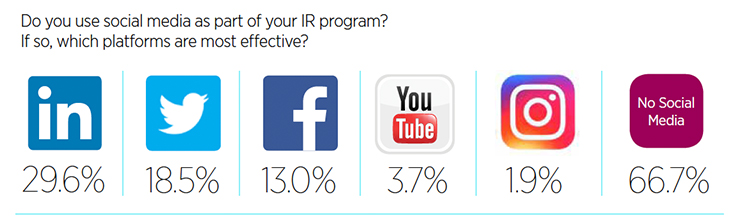
In terms of being proactive, REIT IR teams appear to prefer more traditional methods of communication to social media platforms. According to NAREIT’s survey, 67 percent of IR professionals are not using social media as part of their IR messaging.

Bujnicki says social media isn’t as “meaningful” a tool for IR as it is for the operating side of the company. While Kimco does use Twitter to disseminate financial information, Bujnicki highlights the importance of “continuing to meet with investors and analysts and articulating the strengths of our portfolio in any given economic environment.”

For Hersha, property tours are particularly effective, according to Majeski. “Any time that we can show investors our properties, it gives them a great opportunity to see how we differentiate the assets that we own and the operations that we run,” he says.

While Equinix has been looking at expanding the use of social media for IR purposes, Rymill says face-to-face meetings still “tend to be very effective in establishing relationships.” She cites the company’s Analyst Day event as “the best way to get people up to speed,” particularly with the complexities of data centers.

Brendan Maiorana, senior vice president for finance and investor relations at office REIT Highwoods Properties (NYSE: HIW), explains that for investors already familiar with the company, meetings with local property management teams are important.

“A big driver of the appeal of our company is our portfolio and the teams we have in the markets where we operate,” he explains.

More Time with Non-Dedicated Investors

An increasing number of IR conversations are being conducted with non-dedicated REIT investors.

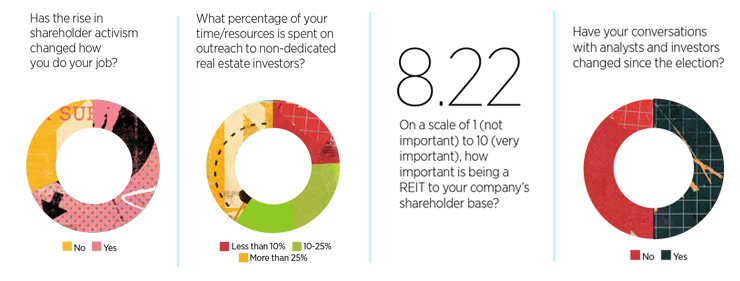
NAREIT’s survey shows that 41 percent of REIT IR professionals spend more than 25 percent of their time and resources on this group. Maiorana sees the elevation of real estate to a separate sector in the Global Industry Classification Standard (GICS) and the maturation of the REIT market as catalysts for their increased participation. As a result, “we’re trying to do more work to garner interest from that constituency of investors,” he adds.

Krewson-Kelly said interest from non-dedicated investors increased “materially” at the beginning of 2016, prior to the GICS carve-out in September. The company is splitting its time about evenly between dedicated and investors, she notes, which isn’t necessarily a big change for COPT. “Our IR outreach has always embraced non-dedicated generalist investors.”

Bujnicki says he has also seen many more non-dedicated investors start to reach out and have discussions,  although he notes that the situation has been “harder of late” due to generalists’ fears about the impact of rising interest rates.

For Equinix, which converted to a REIT in 2015, the emphasis has been in the other direction. “We’ve gone from spending zero time with REIT investors to trying to dedicate as much as we can,” Rymill notes.

Keeping a Close Eye on Activists

A majority of survey respondents said the rise of activist investors hasn’t changed how they do their jobs. Yet, as they meet with both dedicated and non-dedicated investors alike, that doesn’t mean they’re not paying close attention to potential challenges.

“You’d be foolish for it not to be on your radar,” states Majeski. Even without an activist investor involved with your company, “it’s always good to regroup and recalibrate and make sure you’re telling the right story to your investors.” 

According to one survey respondent, “everyone is more aware of activists and what can happen to companies that do not listen to shareholders.” One respondent whose company had been targeted by activists commented, “We are mindful of making sure we are always pushing our story out.”

“We spend much more time on governance issues than we did 10 years ago,” another respondent noted.

Equinix’s Rymill says she monitors whom the company meets with and pays attention to shareholders who tend to have an activist nature. “Internally, we make sure we are prepared and run through those different scenarios,” she points out.

Importance of Being a REIT

On a scale of one to 10, with 10 signifying “most important,” REIT IR professionals ranked the importance of being a REIT at eight.

Krewson-Kelly thinks the compulsory dividend component of the REIT structure will always carry weight with investors. “The global demand for passive fixed income that comes from a dividend-paying stock has only grown. With the aging demographics in the U.S. and other countries, it’s very important,” she says.

For his part, Maiorana sees many advantages to being a REIT in the eyes of shareholders. “It’s a very effective corporate structure,” he says.

Bujnicki rates the importance for Kimco of being a REIT at 10.

“Being a publicly traded REIT, there tends to be greater transparency, better disclosure and greater access to capital. Publicly traded REITs also own the highest-quality properties,” he states. 

(Why?)

Published at Tue, 30 May 2017 14:37:31 +0000

Foreign Investors Still Keen on U.S. Real Estate

Foreign Investors Still Keen on U.S. Real Estate

In the latest episode of The REIT Report: NAREIT’s Weekly Podcast, Michael Schwartz, principal with RMS, discussed trends in foreign investment in U.S. real estate.

Schwartz offered his thoughts on the impact of changes to the rules from the Foreign Investment in Real Property Tax Act (FIRPTA). He noted that the reforms have played a role in stimulating demand in U.S. real estate from abroad, albeit not an overwhelming one.

In terms of other factors driving that demand, Schwartz cited the limited number of opportunities available in the Asian real estate markets. He pointed out that secondary markets outside the gateway cities in the U.S. are relatively strong.

“The U.S. provides for such a depth and breadth of investment possibilities,” he said, “both from the product type as well as the markets.”

Foreign investors are showing particularly high interest in industrial real estate assets, according to Schwartz. Office buildings in major markets also remain popular, he said.

Schwartz also mentioned that the Federal Reserve’s monetary policy moves haven’t scared away interest.

“Interest rates are not a huge factor,” he said. “Folks are already taking consideration in their underwriting.”

(Subscribe to The REIT Report via iTunes.)

(Why?)

Published at Fri, 26 May 2017 14:56:09 +0000

Cousins Properties Refocusing on Urban Properties

Cousins Properties Refocusing on Urban Properties

In this real estate cycle, properties in gateway cities such as New York and San Francisco have drawn intense attention – and competition – from investors clamoring for a piece of an iconic skyline. However, Cousins Properties Inc. (NYSE: CUZ), an Atlanta-based office REIT, is staying true to its focus on six Sun Belt markets.

The company’s leadership studies each market carefully to identify key submarkets where demand for class-A offices is strong, but land isn’t so plentiful that competitors can easily muscle in with a new trophy building. “A lot of times, the public investors only refer to the New York and the Washington markets as ‘high-barrier,’” says Cousins Properties President and Chief Executive Officer Larry Gellerstedt, an Atlanta native who took the position in 2009. 

Cousins executives (left to right): EVP and CFO Gregg Adzema; EVP, General Counsel and Corporate Secretary Pam Roper; President and CEO Larry Gellerstedt; Director, Investor Relations Marli Quesinberry; EVP and COO Colin Connolly.

“We’ve been able to demonstrate that there are higher-barrier markets even in these lower-barrier” cities.

With about 17 million rentable square feet in its portfolio, Cousins Properties specializes in pockets of its markets where younger workers, who are less interested in a lengthy commute from suburbia, are helping revitalize downtown cores and urban areas. Its 20-story One Buckhead Plaza in Atlanta, for example, is close to public transportation and is stocked with amenities such as a salon and fitness center. A high-end grocery and a hotel are located within walking distance.

“It’s not an urban experience like living in Manhattan, but it’s more of an urban experience than living in some of the suburbs that are 20 miles out,” Gellerstedt said.

Long Story

While Cousins may be one of the nation’s oldest publicly traded real estate companies— it went public in 1962—it has only recently returned to its core office strengths and its long-held mantra to operate with a conservative balance sheet.

While most companies have spent the past few years enjoying the current recovery, Cousins Properties had to deal with the effect of collapsing oil prices in the Houston market. That led the company to a novel strategy.  Last fall, Cousins Properties merged with competitor Parkway Properties Inc. , and then spun off the Houston assets into a new independent REIT just known as Parkway, Inc. (NYSE: PKY). (See below.)

Fifth Third Center (Charlotte)So far, Wall Street applauds the changes devised by the Cousins Properties leadership team.

“They’ve done a good job this cycle simplifying the story,” says Joseph “Jed” Reagan, a senior analyst with Green Street Advisors. “Now they’re one of the best regarded companies in their peer group.”

How it got there, however, is “a long, winding story,” adds David Rodgers, a senior real estate research analyst with Robert W. Baird & Co.

Lessons Learned

Indeed, Cousins Properties has lived several lives since it was founded in 1958 by Tom Cousins, a 26-year-old salesman who went on to build homes, townhomes and, in 1965, an office building in downtown Atlanta. In the 1970s, the company expanded into regional malls, real estate finance and even insurance, only to be forced to retreat to its core products as the market softened. Three decades later, the company received another lesson about the importance of maintaining a laser focus.

Like many real estate investors, Cousins Properties got caught up in the housing boom of the 2000s – when the appetite for everything from homes to office towers was insatiable. And, again, like many of real estate companies, Cousins Properties felt the pain of a popping bubble.

Gellerstedt points to a development known as Terminus as a microcosm of what happened during the period. Construction of Terminus 200, a cousin to the mixed-use Terminus 100, was launched in 2007. The launch occurred without much preleasing, which was an exception to the company’s normal requirements, and with more leverage than Cousins Properties typically used. It also included residences, something the company had not done in recent years.

Within a few years, the company had to take a write down and later had to restructure the loan as preleasing requirements weren’t met. “They had gotten out over their skis in development and multiple property types,” Reagan recalled. “They kind of lost focus.”

To be sure, Cousins Properties wasn’t the sole real estate company that made such mistakes. “We had a lot of company at that point,” says Gellerstedt, adding that “mistakes are things you learn from.” And, while many of its peers lost assets to foreclosure, Cousins Properties was able to hold on to Terminus 200 until it became a prized asset.

Sharpened Focus

The bruised company emerged from the financial crisis with the mandate of achieving critical mass in its markets, finding sites that will command top dollar in rents, maintaining a conservative balance sheet and having a diversified customer base.  

3344 Peachtree (Atlanta)So far, so good. In Atlanta, Cousins Properties is the number one class-A office owner by square footage with 20 percent market share in the upscale Buckhead area. The same numbers are reported for Charlotte’s Uptown district. The percentage grows to 24 percent in Austin and 28 percent in Tempe.

The company also commands superior rents. Asking rents in Atlanta’s Buckhead are $40.20 per square foot, 49 percent higher than Atlanta overall. In Charlotte’s Uptown, Cousins Properties asks for $33.36 per square foot, 26 percent above that metro area’s average. The national average came in at $31.97 for the fourth quarter, according to Reis Inc.

Cousin Properties’ portfolio, whose assets boast an average age of 20 years, is 93 percent leased, according to financial filings. That beats the national vacancy rate of 15.8 percent, according to Reis, which calculates Atlanta with an 18 percent vacancy rate and Austin at a tighter 12.2 percent. It indicates that the company owns some of the most appealing space in its markets. “You’ll see investors talk about how the quality level of our portfolio really stands out,” Gellerstedt says.

 “Acquiring and developing trophy properties in historically higher-growth CBD submarkets significantly has and should continue to improve the quality of the company’s office portfolio,” Rodgers wrote in a client note earlier this year. “High-quality assets are generally less susceptible to the various stages of the office real estate cycle, require less capital commitments to maintain higher occupancy levels and attract higher credit quality tenants.”

The company also boasts a diversified tenant base, important because gambling too much on one tenant or a specific industry is risky. Currently, no single industry represents more than 20 percent of the customer base. Financial services top 20 percent – with Bank of America being its largest tenant – followed by the legal sector at 15 percent and professional services at 13 percent. Other well-known large and varied tenants include Wells Fargo, Blue Cross Blue Shield and Hearst Communications Inc.

What’s more, less than 10 percent of total tenants will see their leased space expire each year through 2020, buffering Cousins Properties from seeing large blocks of empty space that weigh on net income. Nearly 30 percent of leased space is under contract until 2025 and beyond. 

“It’s really a transformed company,” Reagan says.

Next Chapter

Gellerstedt isn’t done tweaking the firm’s strategy. The 2017 objectives include reducing debt by selling 25 million shares of common equity.

Cousins Properties is also selling some real estate to cement its position as an urban, trophy property owner with a portfolio that charges rents with a premium of as much as 53 percent over competitors. Properties on the market include Atlanta’s American Cancer Society Center, which has a data center, and Emory Point, a luxury residential community near Emory University. The work should reduce exposure to its headquarters city, which grew with the Parkway Properties deal, and minimize  woes should that market sour.

Colorado Tower (Austin)The company has retired $204 million of debt through asset sales and refinanced $358 million at historically low long-term rates, according to financial filings. It has minimal debt maturing in 2018. When compared to peers, the balance sheet is now healthy, according to Rodgers.

With the big picture taken care of, he says it is time for Cousins Properties to “go out there and execute extremely well at the property level,” he says. “That’s what we want to see them continue to do and even get better at.”

Gellerstedt, who has a background in private real estate, says Cousins Properties is primed and ready to deliver. In his previous positions, his job was to find a building, get it stabilized and harvest results. But his task is different now.

“The REIT space, a lot of it is absolutely having an income stream that the investors can count on and put a multiple on. Just building and flipping things is not something that they’re able to do with that,” he says. “It’s not valued at the same level. Having a stable portfolio of assets and a very conservative balance sheet is something that’s certainly valued in this space a great deal, and it’s been fun.” 

Spinning Forward 

Last year, Cousins Properties’ urban office space in the Southern U.S. was still recovering after a deep recession. Tumbling oil prices were weighing on returns and Wall Street analysts were agitating for change.

Executives realized the company had to act. They came up with a creative solution.

Cousins Properties acquired competitor Parkway Properties and simultaneously spun off the combined company’s Houston assets into a separate company, Parkway Inc., which is led by president and CEO James Heistand. That allowed investors who want to make an oil-related real estate play to do just that.

“The move essentially detached Cousins from Houston, which was and is a struggling market and had really been dragging on the stock’s performance,” says Jed Reagan, an analyst with Green Street Advisors. “Strategically, it made sense.”

For now, it isn’t simple to compare current results from the prior year. Stocks of both companies have spent the last several months largely stagnant. Even so, with the stress of the Houston market removed, 

Cousins Properties’ fundamentals appear to be on solid ground. It boasts 33 assets—largely in Atlanta, Charlotte, Austin and Tampa—that are roughly 93 percent leased.

“The merger puts them in a very good position,” says David Rodgers, an analyst with Robert W. Baird & Co.

(Why?)

Published at Fri, 26 May 2017 17:24:13 +0000

One-on-One with MFA Financial, Inc. CEO William Gorin

One-on-One with MFA Financial, Inc. CEO William Gorin

MFA Financial, Inc. (NYSE: MFA) began operations nearly 19 years ago. During that time, the Mortgage REIT has generated strong long-term returns for investors through volatile markets and credit cycles. William Gorin, who has been with MFA from the start, took over as CEO in January 2014. 

MFA Financial primarily invests in residential mortgage assets, including residential mortgage-backed securities and residential whole loans, on a leveraged basis. According to Gorin, MFA’s permanent capital REIT structure gives it the staying power to hold assets through fluctuations in market value.

Gorin, chairman of NAREIT’s Mortgage REIT Council, recently spoke with REIT magazine about the company’s 29 percent total shareholder return in 2016 and where the Mortgage REIT expects to find growth going forward.

REIT: What has been the most important lesson that you’ve learned so far in your tenure as CEO?

Bill Gorin: As CEO, I’ve come to increasingly appreciate the value of a corporate culture based on teamwork.  As we move ahead as a company, employees need to assist and fully engage with co-workers for the betterment of the company.

REIT: Over the last 10 years, MFA has generated annualized shareholder returns of approximately 13 percent. Last year saw total shareholder returns of approximately 29 percent. What accounts for that performance, and what sort of levels do you anticipate longer term?

Gorin:  Over the last 18 years or so, we’ve sought to generate returns in the range of 9 to 11 percent. As you point out in your question, we have historically outperformed this goal. Reflecting upon 2016, certain macroeconomic events and trends, such as the Brexit vote in June, the U.S. presidential election in November and insufficient growth on a worldwide basis, certainly impacted asset values and financial markets. Nevertheless, we were able to identify and take advantage of attractive investment opportunities and provide a meaningful return to our shareholders.

Our total shareholder return of 29 percent in 2016 was due to asset performance, but was also a function of the equity markets in general and, more specifically, Mortgage REITs’ performance in the equity markets. 

REIT: What are the big stories that you see impacting the market dynamics in the near term for MFA and Mortgage REITs as a whole?

Up Close

Age: 58
Education: BA in economics, Brandeis University; MBA, Stanford University.
Family: Wife, Jody; daughter, Allie; and son, Matthew.
Hobbies: Skiing, Design
Favorite Vacation spot: Turks and Caicos Islands.

Gorin: The key variables for MFA and the entire Mortgage REIT universe will probably be the pace of change in the federal funds rate, potential government-sponsored enterprises (GSE) reform and reinvestment activities within the Federal Reserve balance sheet.

REIT: How would you describe MFA’s overall interest rate risk?

Gorin: I believe that MFA’s portfolio has relatively low price sensitivity relative to the changes in interest rates. We acquire lower-duration assets such as hybrid mortgage-backed securities or three-year step-up securities. We have a substantial longer-term swap position and we maintain relatively low leverage ratios. As we saw in the fourth quarter, rising interest rates from an improving economy can have a positive impact on the value of credit-sensitive assets.

REIT: How do you plan to mix mortgage credit exposure with interest rate exposure?

Gorin: The mix between mortgage credit and interest rate exposure will continue to trend toward more credit, given that it’s easy to envision a continued normalization of interest rates in the coming years. In 2017, we’ll continue to focus on credit-sensitive residential mortgage assets.

The credit assets we’ve acquired continue to perform well. They tend to be short term and have less interest rate sensitivity. Many of our assets were purchased at a discount, so they actually benefit from increases in prepayment rates.

REIT: Why is MFA looking to invest in distressed, less-liquid assets?

Gorin: Our investment decisions are based on pricing of assets and our view of potential financial returns relative to risk. This strategy does require staying power, which gives us the ability to invest in and hold long-term, distressed, less-liquid assets.

We view the strategy as attractive because we have permanent equity capital and our debt-to-equity ratio is low enough to accommodate potential declines in marks. MFA has shown the ability to invest significant amounts at advantageous prices while other investors may be facing capital outflows. 

REIT: Does the residential mortgage credit market continue to enjoy both fundamental and technical support?

Gorin: Particularly when you are talking about legacy assets, those that were issued prior to 2008, the fundamentals are that home prices have increased in recent years. From a technical standpoint, they are not making any new 2005, 2006, 2007 vintage mortgage assets, so both the fundamentals and technicals have been strong.

REIT: Will MFA’s sales of legacy non-agency MBS continue?

Gorin: We’re aware that the asset class has significantly declined in size over time, and, generally, we would not want to own a disproportionate share of this asset class. All those things being equal, probably we’ll reduce our exposure as the overall market shrinks.

REIT: As chairman of NAREIT’s Mortgage REIT Council’s executive committee, what are some of the issues on your agenda?

Gorin: The primary goal of the Mortgage REIT Council in 2017 is to interface with the new administration and its appointees relative to a wide range of topics, including tax reform and its impact on Mortgage REITs, GSE reform and the overall role of private capital in U.S. mortgage markets. 

(Why?)

Published at Fri, 26 May 2017 15:18:04 +0000

Building a Healthy Corporate Culture

Building a Healthy Corporate Culture

Over the past 25 years, Camden Property Trust (NYSE: CPT) has grown from a fledgling multifamily company with a handful of assets in Texas to a publicly traded REIT with 53,000 apartment homes across the United States and an enterprise value of $10 billion. The company has been recognized for its growth, innovation and ability to adapt and respond to a dynamic real estate market over that time. But the one thing that has remained unchanged over the years is Camden’s passion for building a healthy corporate culture based on values, integrity and, of course, having fun.

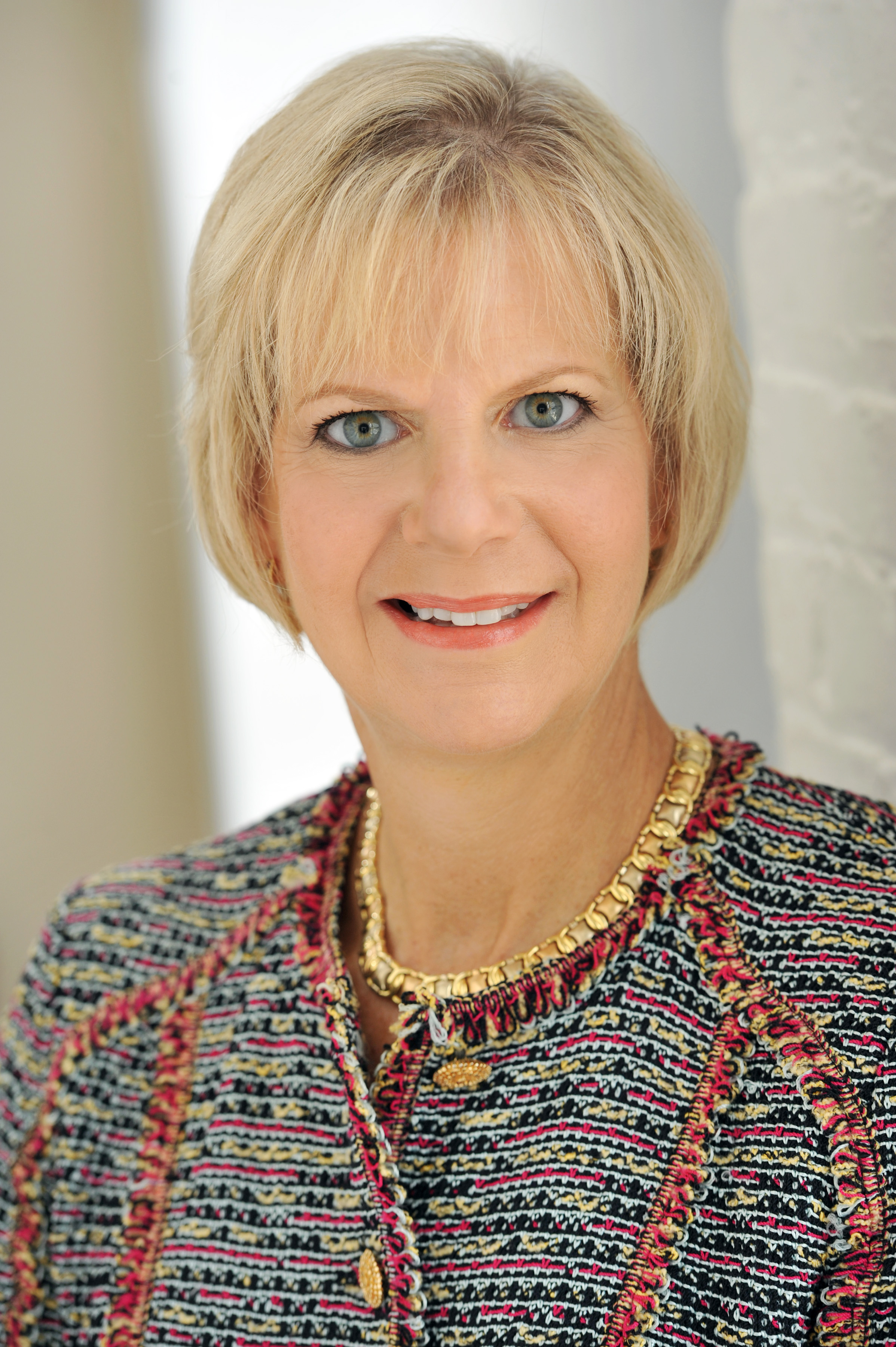
Camden President and co-founder Keith Oden and I recognized early on that happy employees lead to happy families and communities and, ultimately, to happy customers and shareholders. When we founded Camden, our goal was not just to establish a financially viable company, but to create a truly great place to work. We encouraged teamwork, open communication, and most importantly following the nine core values that continue to guide our decisions today: customer focused, people driven, results oriented, team players, lead by example, work smart, act with integrity, always do the right thing, and have fun.

Our commitment to sharing information with and listening to our associates has greatly enhanced the trust and respect amongst us. While we try not to overwhelm our employees with data, we are sure that more information – honest, relevant, helpful and often entertaining – is always better than less.  And we make sure that we take the time to listen and respond to questions, concerns and feedback from our team, often taking actions based on our employees’ input and ideas.

We strive to be approachable and “down-to-earth” and ensure that we are building rapport and camaraderie with all of our Camden team members. Our many company events provide opportunities for sharing key messages, celebrating accomplishments and cultivating our relationships with all employees across our 15 geographic markets. Examples include our Annual Management Conference (attended by more than 400 Camden associates), Achieving Camden Excellence (“ACE”) employee award ceremonies, Camden Cares volunteering and community service efforts, Lagniappe Lunches with employees at the corporate office and many other great events.

We also take pride in sharing our stories and experience and in sharing the wealth.  We know that the many accomplishments and the long-term success of our company would not have been possible without the hard work and extraordinary dedication of our employees. We are proud to continually give back to our team and recognize their efforts with special bonuses, employee appreciation days, and raffles for items such as tickets to concerts and sporting events.

The Camden team has also given back to us in many ways, consistently applauding our company for its excellent work environment and corporate culture. We are honored to be recognized by FORTUNE magazine for the 10th consecutive year as one of the “100 Best Companies to Work For” in America based on the feedback and praise given by Camden’s employees.

Maintaining a great corporate culture requires time and commitment from all levels of our management team. We have always believed that people are our greatest asset and that having the right team united and committed to achieving common goals is the best way to ensure success for Camden and all of its stakeholders.

Ric Campo has served as chairman and CEO of Camden Property Trust since 1993. He co-founded Camden’s predecessor companies in 1982. He also sits on the NAREIT Advisory Board of Governors.

(Why?)

Published at Thu, 25 May 2017 18:45:09 +0000

Merrie Frankel, REIT Analyst, Forms Her Own Consultancy

Merrie Frankel, REIT Analyst, Forms Her Own Consultancy

Merrie FrankelFor nearly two decades, Merrie Frankel has been a familiar face around the REIT industry as a REIT analyst with Moody’s Investors Service. She decided in the fall that she was ready for a change.


In February, she announced the formation of Minerva Realty Consultants, LLC in affiliation with RCLCO, a real estate advisory firm with offices in Washington, D.C., and Los Angeles. The new venture provides credit rating and capital structure analysis to REITs and real estate companies. The firm’s clientele includes listed REITs and private real estate companies seeking strategic analysis, companies considering going public and companies that are working through the ratings process.

When Frankel spoke with REIT magazine in the spring of 2017, she talked about why she made the move into consulting and reflected on some of the challenges faced by the ratings agencies following the financial crisis of the late 2000s.

REIT: So what prompted you to want to make the move into consulting?

FRANKEL: I wanted to create a firm that integrated my knowledge of REITs, the rating process, investment banking, tax and portfolio management while providing a unique and value-added service. Other than a few investment banks with in-house rating advisors, no one is providing independent rating advisory services in the U.S.

Earlier in my career, I was a real estate consultant at Ernst & Young, so I understood that business landscape. I contacted RCLCO with the idea so that I could provide them with REIT expertise and they offer global real estate consultant platform resources.

As an aside, I wanted a fun name for a woman-owned firm. Thus was born Minerva—the Roman goddess of wisdom.

REIT: Tell us a little bit about what you’re doing at Minerva.

FRANKEL: Minerva is unique in providing independent consulting services to assist companies pursuing credit ratings and capital structure analysis for REITs contemplating accessing the public markets or ratings. Minerva’s disciplined process will enable private companies to explore IPOs by mapping out the optimal approach to going public and guide listed and non-listed real estate firms through the rating process.

REIT: You mentioned Minerva’s “disciplined process.” What does that consist of?

“The methodological and consistent manner in which REITs have continued to perform from the recession through today is notable.” – Merrie Frankel

FRANKEL: Looking strategically at the company’s financials, market position, and resources to assess their ratings potential, whether public or private and help them navigate the process.

REIT: How does RCLCO factor into what you’re doing?

FRANKEL: While developing Minerva’s goals, I decided that I wanted to have access to a larger firm’s resources for certain assignments. Through Minerva’s affiliation with RCLCO and their reputation for excellence in strategic real estate intelligence, we can completely service clients by providing them with a single source for strategic advice.

They have great depth and breadth of people to perform market and portfolio analysis. Affiliating just made a lot of sense.

REIT: What are some of the main questions that you’re fielding from clients and prospective REIT management teams?

FRANKEL: The reception to Minerva has been wonderful. From basic questions about REIT structuring and the rating process to more intricate inquiries about the various sectors. I want to guide companies through the ratings process so that it’s easier for potential public and private REITs to navigate and understand.

REIT: Looking at how real estate companies in the U.S. are accessing the capital markets, are there any major developments or trends that are of interest to you?

FRANKEL: Some of the newer trends that I’m watching include more development and the growth of specialty REITs, such as those involved in data centers and technology infrastructure. There is some uncertainty regarding how tax reform will affect REITs and how much capital will flow into REITs due to the creation of the new GICS [Global Industry Classification Standard] real estate class.

The methodical and consistent manner in which REITs have continued to perform from the recession through today is notable. Although headline risk continues for some sectors, operating fundamentals are solid. REITs have maintained their liquidity by issuing more unsecured debt than ever in 2016 ($37 billion), accessing the equity markets, and maintaining strong portfolios despite store closures and bankruptcies.

REIT: As someone who was directly involved with the ratings process, are there any particular challenges posed in rating real estate companies versus other industries? And, specifically, what about REITs, given the unique nature of their business model?

FRANKEL: The challenges to REITs lie in the consistent need for liquidity since they must pay out 90 percent of their taxable income in dividends and maintain solid portfolios despite tenant issues, but diversification remedies this.

If a large percentage of a REIT’s properties are occupied by one tenant, that might create some issues. However, if the REIT is diversified by tenant and geography, that can alleviate some challenges.

REIT: You were with Moody’s for nearly two decades before coming to Minerva, so you have a sense for what it was like during the financial crisis. The reputations of the ratings agencies clearly took a hit in the aftermath of the meltdown in the credit markets. Do you think they’ve recovered?

FRANKEL: The ratings agencies have recovered to a great extent due to more transparency with clients and extensive methodologies for each sector that are shared with their clients. Companies are provided with a better road map regarding the agencies’ criteria to rate each sector, which resulted from the recession and the feedback from the market.

At Moody’s now, there are approximately 250 detailed methodologies for the different sectors – real estate is just one. That, in turn, created more transparency.

Merrie Frankel is the president of Minerva Realty Consultants, LLC, a REIT and credit rating advisory firm. Previously, she was a vice president and senior credit officer in the commercial real estate finance group at Moody’s Investors Service from 1998 until August 2016, where she oversaw a ratings portfolio of REITs and real estate operating companies in the U.S. and Canada. Prior to joining Moody’s, Frankel was a senior vice president and director of portfolio management for the Argo Funds and has also worked for Cushman & Wakefield, JP Morgan, and Salomon Brothers. She holds J.D. and M.B.A. degrees from Hofstra University and a B.A. in English from the University of Pennsylvania.

(Why?)

Published at Thu, 25 May 2017 14:40:22 +0000

Potlatch Prepares for the Future of Timberlands

Potlatch Prepares for the Future of Timberlands

Potlatch Corp. (NASDAQ: PCH) was founded in 1903 near the vast white pine forests of north-central Idaho. By 1906, the company owned a portfolio of considerable timberland holdings and had constructed a state-of-the-art lumber mill. It had even built a town for its employees and their families.

Today, Potlatch owns 1.4 million acres of timberlands across five states. This includes 615,000 acres in northern Idaho, 604,000 acres combined in Alabama, Arkansas and Mississippi, and the remainder in Minnesota.

Overall, Potlatch is a top 10 lumber producer in the United States.

AT A GLANCE

Address:
601 West First Avenue
Suite 1600
Spokane, WA 99201
Phone: 509.835.1500
Website: potlatchcorp.com
Management Team:
Michael J. Covey, Chairman and CEO
Eric J. Cremers, President and COO
Jerald W. Richards, Vice President and Chief Financial Officer
Lorrie D. Scott, Vice President, General Counsel and Corporate Secretary

“During our 12-decade history, we engaged in nearly every aspect of the industry, including pulp and paperboard, liquid container manufacturing, household tissue products, remanufactured wood products and engineered wood products such as oriented strand board,” says Michael Covey, chairman and CEO of the Spokane, Washington-headquartered company. “Our return to a simple timberland and solid wood products manufacturing structure over the last decade has proven to be the perfect niche for Potlatch.”

In the last 20 years, investors purchased millions of acres of U.S. timberlands as part of a shift by numerous integrated forest products companies focusing on manufacturing. Potlatch retained its integrated solid-wood-manufacturing model when it became a REIT in 2006. Its manufacturing and other businesses complement its timberlands and are held in a taxable REIT subsidiary.

The REIT election “increased the value of Potlatch’s timberlands and provided the company the ability to offer more competitive prices in the timberland acquisition market,” Covey says.

Key Acquisition Strategy

After a number of acquisitions and mergers within Idaho during its first 25 years, Potlatch expanded operations outside the Gem State through mergers with the Southern Lumber Company in Arkansas in 1956, the Bradley Lumber Company in Arkansas in 1958 and the Northwest Paper Company in Minnesota in 1964.

In 2014, it purchased 201,000 acres in Alabama and Mississippi for $384 million.

“These high-value timberlands are located in markets with strong wood demand,” Covey says. “The acquisition diversified our southern timberland ownership into two new states, which provides the ability to leverage new and existing customer relationships as well as provide a new beachhead for bolt-on acquisitions. The transaction was immediately accretive to our cash available for distribution, and was the catalyst for a 7 percent increase in our dividend in the fourth quarter of 2014.”

Steve Chercover, a managing director and senior research analyst with D. A. Davidson in Portland, Oregon, who covers three of the four timberland REITs, says he likes what Potlatch has done over the last decade, citing the company’s “opportunistic” buying patterns. He points out, however, that like all timberland REITs, the company is facing challenges from pressure on southern sawlog prices. “The space is pretty mature and fair valued,” Chercover says of the timberland REIT sector.


Earlier this year, Raymond James’ REIT analysts gave Potlatch an “outperform” rating, citing expectations for a move back to some form of managed trade policy to be a positive for the timber REITs. The report said that Potlatch was one of two timber REITs (Weyerhaeuser being the other) that stands to benefit most from higher lumber prices due to direct exposure.

Roots for Growth

With most of its activity currently in Idaho and the U.S. South, Covey notes Potlatch leadership often says the next dollar it expects to invest through an acquisition would be in the U.S. Central Gulf South.

“This could be anywhere from East Texas to Alabama, which would complement our current footprint in Arkansas, Mississippi and Alabama,” he says. “Timberland ownership in the South is highly fragmented, and southern sawlog prices are poised to recover to trend levels as the U.S. housing market recovery continues.”

A challenge to further acquisition is that there’s been a high degree of interest in investing in timberlands,particularly in the South of late, according to Covey. He notes that successful acquirers of timberlands have been using low discount rates and assuming near-term recovery in southern sawlog prices.

“Our return to a simple timberland and solid wood products manufacturing structure over the the last decade has proven to be the perfect niche for Potlatch.” – Michael Covey, Chairman and CEO, Potlatch

Additionally, a number of timberland owners deferred harvest in the South during the recent recession, which created a surplus of standing inventory. Unlike most real estate investments where vacancy can lead to lost revenue, a decision to defer timber harvests just postpones the cash flow and allows the trees to grow in size.

“That has resulted in fully priced transactions,” Covey says. “That is a good thing in the context of being a timberland owner, but it makes finding accretive acquisitions challenging.”

Mark Weintraub, director of Buckingham Research in New York, raises an intriguing possibility for Potlatch’s future.

“I expect [Potlatch] to continue to look for bolt-on acquisitions, and there’s a question longer term of whether or not there may be a merger with another entity,” he says. “It’s all about timberland, and the question is should they run as is, do they grow or do they merge? They’ve done some portfolio shifting, but I think they’ve been smart in biding their time and being patient making that next move.”

For now, Covey sees lasting success in the future for the company despite the potential for obstacles in the short term. He points to the continued recovery in the U.S. housing market as one positive factor. Additionally, strong repair and remodel markets are providing significant tailwinds.

“Over time, stronger prices for lumber and plywood needed to support the nation’s housing industry translate into higher prices for the trees that we grow,” he says.

(Why?)

Published at Tue, 23 May 2017 21:04:03 +0000

The Importance of IR Outreach

The Importance of IR Outreach

Investor relations is a critical component to any publicly traded company. Over the years, REIT IR professionals have worked hard to ensure dedicated REIT investors are 
well versed in the REIT approach to real estate investment and its benefits. However, since real estate was promoted to its own headline sector within the Global Industry Classification Standard (GICS) last year, the importance of IR outreach to a far broader set of potential investors has grown exponentially.

Many of these generalists have limited experience in dealing with the nuances of REIT investment. Consequently, as the first point of contact between their companies and the investment community, REITs’ IR professionals now must employ an increasingly diverse and complex set of skills to serve an expanding group of stakeholders.

The “Inside Outreach” feature in this issue of REIT magazine highlights just how much IR roles at REITs have evolved in recent years. NAREIT polled more than 50 IR heads to get the straight story on a range of issues. Not surprisingly, 41 percent of respondents said they now spend more than a quarter of their time and resources on non-dedicated investors.

In response, NAREIT is taking steps to address the changing needs of IR professionals and to encourage sharing ideas and information among its member companies. That includes establishing an advisory council of IR professionals to identify and address emerging issues for their departments. On June 5, the first-ever REIT Investor Relations Symposium will be held at the NYSE. The invitation-only event, which will be co-sponsored by NAREIT and the NYSE, will help IR professionals to exchange ideas and best practices. Topics at the event will include effective strategies to communicate with investors, insights from veteran REIT analysts on how they acquire and process information from listed companies, and more.

NAREIT also serves as a resource for IR departments by curating important REIT-related information, the vast majority of which can be found on NAREIT’s home website, REIT.com. This includes more than just data on performance metrics. For example, REIT.com users can find detailed information and analysis of relevant policy issues and reporting on the latest developments and trends in the industry.

In addition, NAREIT creates and manages content that can be used by IR professionals to help introduce REIT investment to newcomers and offer a richer understanding of the industry to those with a greater level of familiarity. These include everything from the interactive maps of REITsAcrossAmerica.com to TheREITWay.com, a website dedicated to illustrating how REITs affect our daily lives, the communities around us and the economy.

I encourage NAREIT member companies to participate in helping to build a thriving network of IR professionals who share ideas and strategies for keeping the investing world informed about the REIT approach to real estate investment.

Tim Naughton
Chairman & CEO
AvalonBay Communities, Inc.

(Why?)

Published at Mon, 22 May 2017 15:32:32 +0000

A REIT Road Trip: “That's Owned by a REIT”

A REIT Road Trip: “That's Owned by a REIT”

It is a parental obligation to frequently remind your children how much more difficult life was when you were growing up. When I tell my three kids stories about life B.I. (before the internet), I am usually met with some combination of eye rolls and exasperated sighs. Some struggles just don’t transfer across generational gaps.

Long before the Griswold clan piled into their classic station wagon bound for Walley World, road trips have been a source of family bonding (and dread) from coast to coast. As a kid, I remember hours upon hours spent crammed in the backseat of a Subaru hatchback with my two sisters driving through northern Maine.

Over spring break, my wife and I drove our three kids from Maryland to Florida to see their grandparents—and thousands of strangers at Universal Studios. In-car DVD players, satellite radio and mobile games have certainly made passing the time on America’s highways more tolerable for kids today—and peaceful for their parents in the front seats.

Over the nearly 16-hour drive along Interstate 95, the only sounds we would hear from the backseat were periodic shouts of “the movie is over” and “I have to pee.” The next most common phrase, to my wife’s chagrin, came from me: “that’s owned by a REIT.” It is one she has become accustomed to as a byproduct of having her husband work for NAREIT.

However, most folks driving on that highway are oblivious to the REIT-owned assets all around them. There were shopping malls and outlet centers, hotels and office buildings. You drive by numerous warehouses and self-storage facilities. There was even a REIT-owned billboard advertising a REIT-owned health care facility. Too busy checking your email to look at the window? Well, all those REIT-owned cell towers nearby are making that possible.

In total, REITs own nearly 200,000 real estate assets across the country, representing nearly $2 trillion in gross asset value. If you want a better sense of the breadth of their portfolios, I encourage you to visit the interactive map NAREIT created at REITsAcrossAmerica.com.

While REITs help house the U.S. economy by providing much of the real estate where we live, work, shop and spend our leisure time, that is only part of the story. On a more local level, REITs are helping to shape local communities through new development or renovating existing properties that have fallen into disrepair. REIT development projects can mean new jobs, better infrastructure, increased economic activity and other enhancements to the quality of life for the surrounding community.

These projects are regularly highlighted in REIT magazine. In this issue, we spotlight the positive impact GGP’s (NYSE: GGP) Ala Moana Center has had to the local community in Honolulu and the state of Hawaii by providing more than 3,000 regular jobs in addition to numerous construction jobs and millions of dollars in tax revenue to the state. On top of that, it is the largest, and one of the most visually stunning, open-air shopping centers in the world.

In fact, better tell the kids to charge their iPads; I think I have an idea for our next family trip.

(Why?)

Published at Mon, 22 May 2017 15:54:54 +0000